I have been privileged, for the first time in my life, to see three Arabic Shakespeare plays in three nights. All came from places lately known in the UK more as political hotspots than as theatre centers: South Sudan, Iraq, and Palestine. Each took a different approach to the question of Shakespeare and national allegory. All were great fun to watch, in completely different ways and for different reasons. (Incidentally no one else is analytically lumping them together as "the Arabic plays" at the World Shakespeare Festival and Globe-to-Globe; only I'm doing that, mainly for the simple logistical reason of seeing them back to back. There will also be a Tunisian Macbeth in July; I hope to report on that too.)
In the South Sudanese Cymbeline, the main political statement was the presence of this production, hence of this language and these African costumes, at the Globe, hence on the world stage. ("QiSSa qadima min balad jadid" as they put it.) The plot was secondary; it only mattered for a moment that Caesar (Sudan) was trying to extract tribute from Britain (South Sudan (how's that for a post-postcolonial reversal)) and that the last words of the play in Arabic were "ittifaqiyat al-salam" (peace accord). Allegory was an excuse for the much more impressive fact of literal physical presence. See, we're here.
In Romeo and Juliet in Baghdad in Stratford-upon-Avon (on which at least one full post to come), allegory was handled more straightforwardly. Parallels were explored, equivalencies and correlates found. The two families had been at war for nine years: since 2003. Romeo was Shia; Juliet was Sunni; old Capulet nearly married her off to Paris, a mujahid with al-Qaeda (on whom everything could conveniently be blamed at the end). Old Capulet and Montague were brothers, estranged after 30 years of Capulet cheating Montague of his rightful profits of their shared boating or pearl-diving business, while now after nine years Old Capulet longed to "feel his hands on the steering wheel" again - ship of state anyone? (First-cousin marriage is fine in Iraq, sometimes even preferred, so that change didn't confuse the star-crossed lovers.) And so on. There were other things going on too, such as the way the casting hearkened back to a golden age of pre-Saddam Iraqi culture, but I won't go into them here, because they would work best for an Iraqi audience. Here I'll stick to the allegory of "in Baghdad" as presented in Stratford.
In this allegorical setup, the departures from Shakespeare's R&J signified as much as the parallels: for instance, the fraternal relationship between the two feuding families; the absence of a Rosaline plot; the prior relationship between R&J, who had loved each other and been kept apart since childhood; an original and moving scene in which Lady Montague rouses the conscience of her brother-in-law Capulet, who then curses surrendering his country to al-Qaeda/Paris (Sunni Awakening anyone? the musicians even played "Frere Jacques" to make sure everyone got it); the fact that no sententious wrapup is spoken at the end after the final explosion (al-Qaeda blows up a church) in which the young couple is killed. Of course this setup also allowed aspects of Iraqi realia to be smuggled into the sedate premises of the Swan Theatre: notably a lot of VERY loud explosions and gunfire. Also some costumes, some wedding customs, adoration of the Barcelona soccer team, and of course the Iraqi colloquial Arabic language. See? those elements seemed to say, this is our reality, here it is, try to understand it.
The Palestinian show (al-Ashtar theatre, again at the Globe) was the most intriguing. It sidestepped allegory almost entirely, presenting a "straight" and quite beautiful production of Richard II that happened to be performed in (modern literary) Arabic. Performing for Londoners who had taken the trouble to see a play in a foreign language (and now wanted some ethnography or political commentary for their trouble), this was a risky move. It prompted an eminent Shakespearean who saw the show to ask what the company had "added to the play." But I loved it. For me it recalled the best aspects of the 1960s Arab dream -- not of Arab unity, but of a seat at the table of world culture. The lovingly deliberate conservatism served to reclaim the metropolitan voice - the right to stand before anyone as an equal and with no discount made for being "from" somewhere. It was simply a good performance. On the way out I heard the couple behind me discussing the ingenious (and it really was) way the production represented characters' onstage deaths - nothing about Palestine at all. See? We are not simply "local" Shakespeare. We have art just like you.
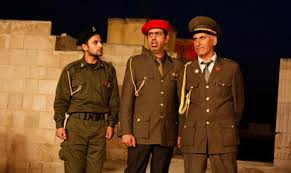 If there were elements of the Richard II production that alluded to contemporary Arab reality, they mostly stayed far from Palestine, instead pointing vaguely to Arab military dictatorships as such, Saddam Qaddhafi, whatever (as you can see in the picture - this is Bolingbroke shortly before his coup, with Northumberland and Ross). This was done through the costumes and in the Jericho performance it must have been reinforced through the ruined-castle setting. But there was no effort to assign one-to-one Shakespearean labels to particular Palestinian characters or groups (e.g., Hamas or Fatah) or Arab events (e.g., the way Mubarak was deposed only to be replaced by his own top generals). None of that even seemed to matter. The company's main work, according to the pre-show talk some of them gave (on which more later), had been to work back and forth with their director, who is Irish and knows no Arabic, to find the right Arabic equivalents, not cultural but mainly just linguistic, for each dense Shakespeare line (and it's a very dense play with a lot of rhetorically scintillating bits). They succeeded wonderfully in places; apparently members of the Jericho audience told them it sounded as though Shakespeare had originally written the play in Arabic.
 A few moments of political-allegorical resonance emerged organically, non-systematically from this process of working through to a poetic prose translation. For instance, my friend Katie and I both found it impossible not to hear John of Gaunt's famous speech about his self-betraying homeland
Pictures, info, and reviews of Ashtar's Richard II are on Facebook. Best of all, see it for yourself in Oxford on Monday or during what I hope will be a long run in Palestine and internationally.
In the South Sudanese Cymbeline, the main political statement was the presence of this production, hence of this language and these African costumes, at the Globe, hence on the world stage. ("QiSSa qadima min balad jadid" as they put it.) The plot was secondary; it only mattered for a moment that Caesar (Sudan) was trying to extract tribute from Britain (South Sudan (how's that for a post-postcolonial reversal)) and that the last words of the play in Arabic were "ittifaqiyat al-salam" (peace accord). Allegory was an excuse for the much more impressive fact of literal physical presence. See, we're here.
In Romeo and Juliet in Baghdad in Stratford-upon-Avon (on which at least one full post to come), allegory was handled more straightforwardly. Parallels were explored, equivalencies and correlates found. The two families had been at war for nine years: since 2003. Romeo was Shia; Juliet was Sunni; old Capulet nearly married her off to Paris, a mujahid with al-Qaeda (on whom everything could conveniently be blamed at the end). Old Capulet and Montague were brothers, estranged after 30 years of Capulet cheating Montague of his rightful profits of their shared boating or pearl-diving business, while now after nine years Old Capulet longed to "feel his hands on the steering wheel" again - ship of state anyone? (First-cousin marriage is fine in Iraq, sometimes even preferred, so that change didn't confuse the star-crossed lovers.) And so on. There were other things going on too, such as the way the casting hearkened back to a golden age of pre-Saddam Iraqi culture, but I won't go into them here, because they would work best for an Iraqi audience. Here I'll stick to the allegory of "in Baghdad" as presented in Stratford.
In this allegorical setup, the departures from Shakespeare's R&J signified as much as the parallels: for instance, the fraternal relationship between the two feuding families; the absence of a Rosaline plot; the prior relationship between R&J, who had loved each other and been kept apart since childhood; an original and moving scene in which Lady Montague rouses the conscience of her brother-in-law Capulet, who then curses surrendering his country to al-Qaeda/Paris (Sunni Awakening anyone? the musicians even played "Frere Jacques" to make sure everyone got it); the fact that no sententious wrapup is spoken at the end after the final explosion (al-Qaeda blows up a church) in which the young couple is killed. Of course this setup also allowed aspects of Iraqi realia to be smuggled into the sedate premises of the Swan Theatre: notably a lot of VERY loud explosions and gunfire. Also some costumes, some wedding customs, adoration of the Barcelona soccer team, and of course the Iraqi colloquial Arabic language. See? those elements seemed to say, this is our reality, here it is, try to understand it.
The Palestinian show (al-Ashtar theatre, again at the Globe) was the most intriguing. It sidestepped allegory almost entirely, presenting a "straight" and quite beautiful production of Richard II that happened to be performed in (modern literary) Arabic. Performing for Londoners who had taken the trouble to see a play in a foreign language (and now wanted some ethnography or political commentary for their trouble), this was a risky move. It prompted an eminent Shakespearean who saw the show to ask what the company had "added to the play." But I loved it. For me it recalled the best aspects of the 1960s Arab dream -- not of Arab unity, but of a seat at the table of world culture. The lovingly deliberate conservatism served to reclaim the metropolitan voice - the right to stand before anyone as an equal and with no discount made for being "from" somewhere. It was simply a good performance. On the way out I heard the couple behind me discussing the ingenious (and it really was) way the production represented characters' onstage deaths - nothing about Palestine at all. See? We are not simply "local" Shakespeare. We have art just like you.

This royal throne of kings, this scepter'd isle,
This earth of majesty, this seat of Mars,
This other Eden, demi-paradise,
This fortress built by Nature for herself
Against infection and the hand of war,
This happy breed of men, this little world,
This precious stone set in the silver sea,
Which serves it in the office of a wall,
Or as a moat defensive to a house,
Against the envy of less happier lands,
This blessed plot, this earth, this realm, this England,
...as a lament about more contemporary losses. As the actor knelt and crushed imaginary soil in his fingers, one could feel exactly what this speech would mean to a Palestinian cast and audience. And then the play moved on, without belaboring the point, without forcing a one-to-one assignment of allegorical labels. (Remember Iman Aoun's comment that I quoted in an earlier post: "Yes, at some point you could see a Palestinian dress onstage, or you could see people dressed in Middle Eastern outfits, but it does not particularly say that this is happening here in Palestine or in a particular Arab city. We want the audience to concentrate and think.") The Shakespeare text was allowed to reshuffle, perhaps slightly to deepen, the recurring disappointments of Middle Eastern politics: divine-right kingship, military coups, out-of-touch yet image-obsessed leaders, the overvaluation of rhetorical beauty, etc. Because the acting was so strong, it worked.
Is now leased out, I die pronouncing it,
Like to a tenement or pelting farm... [etc etc]
Pictures, info, and reviews of Ashtar's Richard II are on Facebook. Best of all, see it for yourself in Oxford on Monday or during what I hope will be a long run in Palestine and internationally.


