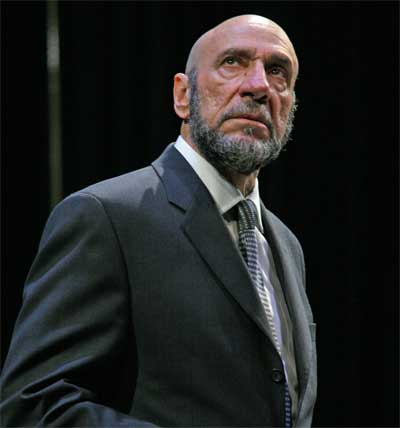
Young Egyptian director Hani Afifi will stage his Hamlet adaptation, انا هاملت or I'm Hamlet, as part of the London 2012 festival around the Olympics, reports the Seventh Day site (in Arabic). The play premiered at Cairo's Creativity Center in the summer of 2009 and was well received at the Cairo International Festival of Experimental Theatre that September; Muhammad Fahim, in the role of Hamlet, won the festival's Best Actor prize. My favorite line is where Hamlet asks Ophelia (in the equivalent of the nunnery scene, which takes place at Cairo's upscale Cafe Cilantro: "But how can I date someone who has 500 friends on Facebook?"
On Shakespeare translations, productions, adaptations, spin-offs, and parodies in Arab countries as well as Arab-themed Shakespeare uses elsewhere. Comments and suggestions to arabshakespeare [at] gmail.com.
Wednesday, April 20, 2011
"Ay, commerce you may call it"
From a roundup of Abu Dhabi financial news:
Shares of Abu Dhabi's first real estate firm Aldar Properties gained 2.45 percent to close at Dhs1.68. Earlier in the day, Aldar announced that it development The Souk at Central Market will open its doors in November 2010 [sic], and it will harbour Abu Dhabi's first Shakespeare & Co restaurant, a Grand Stores Digital, a variety of cafes as well as over 20 watch and jewellery stores.
The statement added, "The Emporium at Central Market, primarily a fashion retail destination, will also be home to brands such as E4U, Spinneys, Magrudy's, Ted Baker, Bebe, Evita Peroni Pandora Jewellery, Network, Fabrika, Beymen Business, Alison Nelson Chocolate Bar, Fat burger and Studio Misr."
Tuesday, April 19, 2011
Saad Hariri as Hamlet
Google just came across (on what looks to be some right-of-reasonable Jewish-themed blog) this satirical sketch comparing Saad Hariri to Hamlet (pursued by ghost of his father Rafik, even as evil stepfather Hassan Nasrallah seduces the weak mother/land, Lebanon-Gertrude). Someone posted it back in January, when Saad's government collapsed.
Hamlet [to himself]: And this is why I have returned from Dubai? When I could have as well managed the business from there, enjoying myself like a pig in the mud? Or even from London... oh London, London... And here, what do I have here? Shia, Sunni, Christians, Druze all scheming and aiming to kill each other, the heat, the Syrians, the Hezbollah, the Israelis for crying out loud... who needs all this crap? Now this revenge schtick too... no, I definitely should get a ticket and scram!The framing is better than the writing, but whatcha gonna do? Unlike Hamlet, Saad Hariri has never been known for his eloquence.
Labels:
Hamlet,
Lebanon,
political rhetoric,
Saad Hariri
Tuesday, April 12, 2011
Merchant of Venice in Boston
This is not about "Arab Shakespeare" per se, but I want to write about this production, so I'll use the pretext that Shakespeare's Merchant of Venice does depict an Arab: the Prince of Morocco. Though not as well known as Othello or Aaron the Moor from Titus Andronicus, the Moorish suitor echoes them in certain ways, loving Portia "not wisely but too well." Doomed by his unseemly fascination with luxury commodities (gold!), he chooses the wrong casket (all that glitters!) and quickly leaves the scene.
The show I saw last weekend, by Theatre for a New Audience (directed by the Yugoslavian-born Darko Tresnjak) at ArtsEmerson in Boston, made the strange decision to costume the Prince of Morocco (the fine African-American actor Raphael Nash Thompson) as Gulf Arab royalty. Here he is flanked by Portia and her staff on the left, his own weird attendants (why does his head of security look like a flight attendant for Emirati Airlines?) on the right. Yes, that's an engraved sword he's presenting to Portia.
What's up with this? The role is unabashed ethnic caricature, and in modern productions a sort of turbaned Leo Africanus (or Moorish Ambassador) getup is typical. But playing the Prince this way let Tresnjak emphasize that this production was really about money as much as ethnic difference. Portia (Kate MacCluggage)'s feelings toward this suitor were ambiguous; she allowed herself several apparently heartfelt racist comments ("May all of his complexion woo me so!"), but she also seemed very attracted to him physically and comfortable flirting with him. The exotic sex appeal? The oil money? Both? Unlike her second suitor, he was a dignified and well-spoken man, a true member of the international aristocracy. In the end she may have been a bit disappointed (though she said otherwise) that he chose the wrong box, the one labeled "Who chooses me will get what many men desire." Childish, conformist Moor. What a pity.
The odd portrayal of the Moor ties in with what was so strange about the whole production. Tresnjak's Venice is made to resemble New York circa 2008, a glitzy and fratty town where the tone is set by young investment bankers flying high on testosterone and Starbucks. The phones are smart and the Wall Street boys are too, trading the smug elbow jabs of financial capitalism at its most arrogant.
The setting has potential, but why isn't Shylock integrated into it? He is simply a man attached to his home and his daughter and his tribe: not even necessarily a banker. This makes him timeless, simply "a Jew." We never see him in anything like a work or office setting; his home is full of decontextualized Jewish kitsch (lanterns, candelabra, vague klezmer music), a weird break from the Apple-store sleekness (as my sister-in-law observed) of the rest of the set. This -- and the fact that Oscar winner F. Murray Abraham's acting towered over that of others, especially the milquetoast Portia -- makes the whole Wall Street setting with its 21st-century shenanigans suddenly irrelevant. The anti-Semitism is frat-boy cruel, but Shylock's response is simple atavism.
Everything else the production has going for it -- Portia's evident jealousy of her Bassanio's love for the closeted Antonio, Jessica's visibly growing nausea at the betrayal she has committed, Gobbo's rap antics -- is overshadowed by this basic failure to integrate the production's strongest character into its underlying premise. Incomplete allegory is the biggest risk of contemporary-dress adaptations; this show succumbs.
By the way, the ArtsEmerson folks all but announced that Al-Bassam's Speaker's Progress is coming to Boston next fall. Stay tuned!
The show I saw last weekend, by Theatre for a New Audience (directed by the Yugoslavian-born Darko Tresnjak) at ArtsEmerson in Boston, made the strange decision to costume the Prince of Morocco (the fine African-American actor Raphael Nash Thompson) as Gulf Arab royalty. Here he is flanked by Portia and her staff on the left, his own weird attendants (why does his head of security look like a flight attendant for Emirati Airlines?) on the right. Yes, that's an engraved sword he's presenting to Portia.
What's up with this? The role is unabashed ethnic caricature, and in modern productions a sort of turbaned Leo Africanus (or Moorish Ambassador) getup is typical. But playing the Prince this way let Tresnjak emphasize that this production was really about money as much as ethnic difference. Portia (Kate MacCluggage)'s feelings toward this suitor were ambiguous; she allowed herself several apparently heartfelt racist comments ("May all of his complexion woo me so!"), but she also seemed very attracted to him physically and comfortable flirting with him. The exotic sex appeal? The oil money? Both? Unlike her second suitor, he was a dignified and well-spoken man, a true member of the international aristocracy. In the end she may have been a bit disappointed (though she said otherwise) that he chose the wrong box, the one labeled "Who chooses me will get what many men desire." Childish, conformist Moor. What a pity.
The odd portrayal of the Moor ties in with what was so strange about the whole production. Tresnjak's Venice is made to resemble New York circa 2008, a glitzy and fratty town where the tone is set by young investment bankers flying high on testosterone and Starbucks. The phones are smart and the Wall Street boys are too, trading the smug elbow jabs of financial capitalism at its most arrogant.
The setting has potential, but why isn't Shylock integrated into it? He is simply a man attached to his home and his daughter and his tribe: not even necessarily a banker. This makes him timeless, simply "a Jew." We never see him in anything like a work or office setting; his home is full of decontextualized Jewish kitsch (lanterns, candelabra, vague klezmer music), a weird break from the Apple-store sleekness (as my sister-in-law observed) of the rest of the set. This -- and the fact that Oscar winner F. Murray Abraham's acting towered over that of others, especially the milquetoast Portia -- makes the whole Wall Street setting with its 21st-century shenanigans suddenly irrelevant. The anti-Semitism is frat-boy cruel, but Shylock's response is simple atavism.
Everything else the production has going for it -- Portia's evident jealousy of her Bassanio's love for the closeted Antonio, Jessica's visibly growing nausea at the betrayal she has committed, Gobbo's rap antics -- is overshadowed by this basic failure to integrate the production's strongest character into its underlying premise. Incomplete allegory is the biggest risk of contemporary-dress adaptations; this show succumbs.
By the way, the ArtsEmerson folks all but announced that Al-Bassam's Speaker's Progress is coming to Boston next fall. Stay tuned!
Monday, April 11, 2011
"Annual Shakespeare Conference" at Biblioteca Alexandrina
Apparently the Shakespeare conference held in April at the Biblioteca Alexandrina is now an annual event. This year's conference was devoted to "The Politics of Power in Shakespeare's History Plays." BA director Ismail Serageldin gave a lecture as part of the proceedings.
Labels:
Alexandria,
Biblioteca Alexandrina,
conferences,
Egypt,
history plays
Tuesday, April 5, 2011
Qadhafi: Shakespeare Was an Arab Named Shaykh Zubayr
I've been looking for a source for the widely known fact that Muammar Qadhafi claimed Shakespeare was not a native-born Englishman but, in fact, an Arab named Shaykh Zubayr.
Cork Milner's site on the authorship controversy gives us this:
M.M. Badawi ("Shakespeare and the Arabs," 1964) and Ferial Ghazoul ("The Arabization of Othello," 1998) trace the Shaykh Zubayr authorship theory to a mid-nineteenth-century Lebanese satirical writer, Aḥmad Fāris al-Shidyāq; it was later taken up in earnest by Iraqi scholar Ṣafā’ Khulūṣī and then painstakingly refuted by Ibrāhīm Ḥamāda in a book-length essay, عروبة شكسبير (“The Arabness of Shakespeare,” 1989). Qadhafi drew Western headlines by mentioning it (perhaps jokingly? who can tell with such a lunatic?) in 1989.
Cork Milner's site on the authorship controversy gives us this:
The most bizarre of all the pretenders is Muammar al-Qaddafi's choice, Sheik Zubayr bin William. Quaddafi came up with his champion in 1989 when Radio Tehran announced that Libya's “Great One” had declared that an Arab sheik named Zubayr bin William, who had been born in the sixteenth century, was Shakespeare.
I should point out that Qadhafi did not originate the bizarre claim that Shakespeare was a crypto-Arab. Usually cited in jest, the Shaykh Zubayr “theory” holds that Shakespeare was actually an Arab Muslim living in Britain. Various authors cite “evidence” including Shakespeare’s full lips and “Islamic” beard in the supposedly "un-English" Chandos portrait(above); his many treatments of mistaken or doubtful identity; and his allegedly unflattering views of Jews, Turks, and the British (supposedly clear in The Merchant of Venice, Othello, and the history plays). Who but an Arab could harbor unfavorable views of precisely these three groups?
But the conceit of an Arab Shakespeare has also appealed to all kinds of intercultural writers addressing Western readers. My favorite is Wole Soyinka in his essay "Shakespeare and the Living Dramatist" (replublished in Art, Dialogue, and Outrage). In a similar vein, Jordanian-Irish-American novelist Diana Abu Jaber in her novel Crescent has an Iraqi-American character invoke the theory, tongue-in-cheek, speaking to an American graduate student: “Did you know that Shakespeare’s favorite food was stuffed eggplant? And there’s some who say that Shakespeare’s name was actually Sheikh Zubayr . . . There’s a nice thesis for you.’” (132). Sulayman al-Bassam resorts to a similar opening gambit in a 2005 Guardian column. So the authorship theory can be a playful bid for intercultural understanding, not only (as with Qadhafi) an insane claim of Arab cultural priority.
By the way, the would-be Arabic name preserves the phallic imagery of spear-shaking. Zubr = penis. So the diminutive zubayr, on one reading, is "little penis." Shake it, Will, habibi!
Thursday, March 31, 2011
Hamlet and Hamlet satire postponed in Egypt
A protest strike by young theatre people (in Arabic) has postponed the presentation at Cairo's high-profile Tal`ia (Vanguard) Theatre of three plays including Hamlet and The Dance of the Scorpions, Mahmoud Aboudoma's 1989 postmodern political Hamlet offshoot. The three were apparently scheduled to run for a full week -- which is a big deal since experimental and youth (or other amateur) plays typically only get to play for one or two nights.
Subscribe to:
Posts (Atom)