Showing posts with label political rhetoric. Show all posts

Friday, August 1, 2014

Hath Not a Jew Eyes? (on Gaza)

Reclaiming and deploying Shakespeare's Shylock as an exponent of empathic (if besieged) humanity, Israeli columnist Gilad Isaacs (@giladisaacs) movingly argues in today's +972mag that Europe's Jews have "lost their humanity" and succumbed to a kind of (uncharacteristic, he says) moral blindness in Gaza. Retelling the story of Jewish emancipation, near-extermination, and nationalist organization in Europe, he concludes:
The Jews are no longer knocking on doors to be let in. We have our own fortress now, bristling with arms. But the cost has been heavy; on the altar of nationalism and ethnic supremacy we have sacrificed the long-cherished ideal of common humanity. Israelis and Zionist Jews, and their most vociferous supporters, can no longer see themselves in the Palestinians. And what we are left with is the second half of Shylock’s speech:
And if you wrong us, shall we not revenge? If we are like you in the rest, we will resemble you in that. If a Jew wrong a Christian, what is his humility? Revenge. If a Christian wrong a Jew, what should his sufferance be by Christian example? Why, revenge. The villany you teach me, I will execute, and it shall go hard but I will better the instruction.

Monday, January 6, 2014

Thursday, December 19, 2013

More on Sisi-mania

How did I miss this back in September?  Egyptian actress Lubna Abdel Aziz publicly wishing that she could have the greatness of Egypt's military savior Abdel Fattah El-Sisi... thrust upon her.  She writes:
Are heroes born, made or chosen? Perhaps, all of the above. William Shakespeare believed, “some are born great, some achieve greatness and some have greatness thrust upon them.” Our hero may be the latter, for he sought nothing, yet emerged unexpectedly, admired and beloved, and in full army regalia, smoothly assumed the role he was born for.
So smooth. More on Abdel Aziz's loony opinions, which have nothing to do with Shakespeare, at the NY Times' The Lede here.

Wednesday, August 21, 2013

El-Sisi as Macbeth

Bloody days in Egypt.  A Pakistani columnist (might they know a thing or two about military dictatorships propped up by a well-manipulated Islamist threat?) predictably and accurately invokes Shakespeare to size up the carnage, implicitly comparing Egypt's de facto ruler Abdel Fattah El-Sisi to Macbeth.  The interesting part is his critique of Mohamed El Baradei, the Nobel laureate/coup backer/fig leaf vice president/perennial tweeter of truth to power whose belated post-massacre bout of conscience has driven him to exile in Vienna.  El Baradei is compared, a bit shockingly to my eyes (is it the gender dimension? or the implication that he has actual blood on his hands?) to Lady Macbeth:
Interim Deputy President of Egypt, Mohamed Mustafa El Baradei, generally considered as a toady of the West, has resigned protesting the military crackdown. However, can he absolve himself of the responsibility? He cannot remove the innocent blood of thousands of innocent Egyptians off his hands like Shakespeare's Macbeth after the murder of Duncan:

“Will all great Neptune‘s ocean
wash this blood,
Clean from my hand? No, this my
hand will rather
The multitudinous seas incarnadine,
Making the green one red” (II:2).

Nobel Laureate El Baradei, rightfully considered as the enemy within, stands among them who have turned red the blue waters of the Mediterranean. History is witness that people, who have innocent blood on their hands and conscience, are judged even posthumously and most often they taste the fruit of their crops in their lives. Shakespeare again points this fact through Macbeth's soliloquy in Act 1 Scene VII very well:

“But here, upon this bank and
shoal of time,
We'd  jump the life to come.
But in these cases
We still have judgment here;
that we but teach
Bloody instructions, which,
being taught, return
To plague the inventor: this
even-handed justice
Commends the ingredients of our
poison’d chalice
To our own lips.”
I don't know enough about Pakistan to pinpoint the local targets of Syed Javed Hussein's critique, but it sounds like there might be some.

Wednesday, January 9, 2013

"To be or not to be an Israeli Arab"

Just came across this 2010 essay in Comparative Literature: "To Be or Not to Be an Israeli Arab: Sayed Kashua and the Prospect of Minority Speech-Acts."  Gil Hochberg's invocation of Hamlet (and, perhaps unintentionally, of a post-simple-nationalist Arab Hamlet tradition) in this context seems felicitous. Whose language to speak? Whose identity to embrace? Which cultural performances will "denote me truly"?

I saw Kashua speak at Tufts last spring, at a wonderful event co-hosted by Jonathan Wilson of the Humanities Center and my friend Amahl Bishara.  At the Tufts Hillel, of all places.  (The plaque behind him says, ironically, "How good and pleasant it is for us all to dwell together.")  Then went home and read his Second Person Singular in two nights.  His major intertext in that book is not Shakespeare but Tolstoy, The Kreutzer Sonata, seen through the prism of Hebrew translation at that. In any case, his observations on the paradoxes of upwardly mobile Arab-Israeli (as he calls it) identity are witty and convincing.

"Alas, poor Syria"!

This editorial cartoon by Habib Haddad just ran in Al-Hayat.  Poor Syria takes the place of the skull.  It's macabre and effective, partly because it follows the usual polemical pattern of personifying the nation as a single person with a single uncertain fate: in this case, Yorick.
h/t David Karjala.

Tuesday, January 8, 2013

Bashar as "Brutus or Macbeth"

Franklin Lamb at Countercurrents writes of Bashar al-Asad's most recent non-concession speech, delivered in operatic style at the Damascus Opera House:
The nearly 1,400 seating capacity Opera Theater was packed for yesterday’s presidential address, and as in the final scene of Mozart’s Opera, the conclusion of Bashar Assad’s performance was followed by, as Mozart wrote, “a night-long celebration” among many of his supporters here in Damascus. Basher Assad’s glory, as he tried to leave the stage last night and was swarmed by scores of admirers, may not have been that of Caesar’s, during the Gallic wars as the latter also portrayed a domestic crisis and challenge as a defensive struggle to save “Rome”. And granted, it is unlikely that Syria’s president will appear to his critics as posh as John Kennedy at Vienna’s Opera House. But the man connected with his audience (s) during his watershed speech. He excelled in delivery, content and, most critically, stating and advocating what he believes is his countryman’s case. While welcoming foreign advice on how to end the current crisis, he insisted that the Syrian people throughout their history of resistance to occupation and hegemony have rejected the orders from certain governments he referred to, in the current crisis, as the “masters of the puppets” who are every day causing death, destruction and deprivations across the Syrian Arab Republic. Admittedly sleep deprived, this observer, as he listened to Bashar Assad’s address was reminded of a Macbeth or Brutus soliloquy. I could not help but transpose in my mind Brutus’ plea in Act 3, Scene 2 of Shakespeare’s Julius Caesar:
“Who is here so rude or unpatriotic that would not be a Syrian? Who is here so vile that will not love his country? If any, speak–for him
I have not intentionally or unjustly wronged. I pause for a reply.”
Following his presidential address to the nation, one local journalist, who is sometimes critical of the regime, elaborated–in answer to my question about Assad’s apparent enduring popularity during this tragic period for people of Syria: “It’s true. And it’s partly due to the fact that he is modest, even humble– and well-educated in contrast to some regional monarchs who are essentially illiterate and uninterested in the world outside their fiefdoms palaces.”
  ... but which is he, Brutus or Macbeth? 

I'm not usually a big fan of Fouad Ajami, but in this case (talking about John Kerry) I think he has hit on the right allusion:
Kerry said Assad delivered on the requests he made. But Fouad Ajami of Stanford's Hoover Institution says Kerry was "snookered."
"Bashar was a very, very talented man with his lovely lady, with his Lady Macbeth, with his wife, at charming foreign visitors and I think the charm worked on John Kerry," Ajami said.
 Because, as in Macbeth, the charm is an inextricable part of the slime.

Wednesday, December 5, 2012

And now Arafat as Hamlet's father's ghost

Was Yasser Arafat "poisoned in the garden for his estate"?  What's sure is that his ghost still stalks the Middle East. Thus Omar Dajani in FP:
The decision to exhume Arafat's remains, almost eight years after his demise, is itself illuminating. Why, many have asked, wasn't it done earlier, when potential evidence of wrongdoing remained fresh? Although it is tempting to suspect a conspiracy, the reality likely hews closer to Hamlet than Julius Caesar. Just after Arafat's death in 2004, a negotiated settlement of the conflict remained a tantalizing prospect: Israel withdrew its troops from the Gaza Strip in 2005, a new Palestinian-Israeli agreement on movement and access was concluded later the same year, and Palestinians returned to the polls in 2006 for the first time in a decade. While many Palestinians suspected from the start that Arafat died from unnatural causes, their leadership, like the court of Denmark in Hamlet, preferred not to be confronted with potentially unpleasant facts about the late patriarch's death. Why inflame the situation just as tempers were cooling? Why risk souring relations with Israel and the United States when progress was close at hand? Wasn't it possible, after all, that Arafat had been the obstacle to peace all along?

Egypt's ElBaradei as "Westernized and Hamlet-like"

Thus spake The Associated Press, at the beginning of the "constitutional" crisis now convulsing Egypt almost exactly as it did one year ago:
The grouping seems to represent a newly assertive political foray for the former chief of the U.N. nuclear watchdog agency. Mr. El Baradei returned to Egypt in the year before Mr. Mubarak's fall, speaking out against his rule, and was influential with many of the youth groups that launched the anti-Mubarak revolution.
But since Mr. Mubarak's fall, he has been criticized by some as too Westernized, elite and Hamlet-like, reluctant to fully assert himself as an opposition leader.

Friday, June 15, 2012

Egypt's unhappy many

"Once More Unto the Breach" is the headline of Sarah Topol's wonderful analysis piece from Cairo, written before the latest developments in Egyptian politics (like the dissolution of the parliament) but already capturing the sense of disillusionment and self-reproach among the activists who helped propel -- and then allowed the military council to squander - the Egyptian revolution.
Alas: despite the Henry V-quoting heading, much of the rest of the mood in the piece is hardly Shakespearean.
"We fucked up a lot," one leading activist tells Topol. "We're always fucking up. Since day one, it's all a series of being fucked over by our own decisions. Since March 2011, it's downhill all the way from there."
More hand-writing abotu current Egyptian politics, for the next week or so at least, on my other blog.

Tuesday, June 12, 2012

Another "Hamlet" protest sign - Syria last spring - in Arabic this time

Just found this too, from Syria. Over a year old: Dera'a, April 2011. Reported here. The sign with two lines of black text right in the middle says "Imma an takuun aw la takuun."  Written in Arabic, in case you were wondering whether only Anglophones use this line. 

Heading back to Cairo, briefly


I'll be in Cairo briefly June 15-23.
Just found this image from Feb 5, 2011 - from the demonstrations in Tahrir that "toppled," as the phrase goes, the dictator Hosni Mubarak. With the bitter wisdom of hindsight we might erase that "toppled" and write in: "allowed the Armed Forces to self-interestedly remove."  The poor girl in this photo - what kind of country will she grow up in?
[Update - image has vanished from Transterra Media web site... this is just a Google cache thumbnail; anyone know how to get it back?]

Tuesday, April 17, 2012

"Hamlet" Abu Ismail

Hamlet headlines a post on the influential Arabist blog about wacko Egyptian presidential candidate Hazem Abu Ismail's "Mama Amreeka" scandal.
(Meanwhile, photos circulating on Facebook show Abu Ismail as a quasi-Egyptian "god of lies."

Monday, January 23, 2012

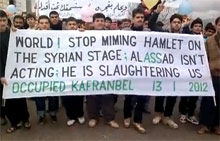
Syrian protesters tap into English theatre tradition

The Guardian finds this English-language sign held up by in Kafranbel, Syria, to be "cryptic."  Why?
(Gotta love the different colored ink on "ASSad," too.)

Monday, December 5, 2011

Or not to be original

In the lead-up to last week's polls in Egypt, not one but two English-language newspapers, AMAY and Ahram Online, ran the headline "To Vote or Not to Vote?" (Thanks, Amy Motlagh.)

Monday, November 28, 2011

"Shakespeare, friend of Arab democracy"


Thanks to all who helped organize or who attended my recent talks at Cairo U, Ayn Shams (Al-Alsun and Drama Dept), and/or AUC. It was humbling and mind-sharpening to do them in light of everything that was happening in Cairo. And is still happening. Happy (to the limited extent possible) Election Day!
Thanks also to Sameh Fekry Hanna from whose dissertation I lifted the 1912 image at left: "Shakespeare, the democratic English dramatic poet."
One more talk coming up at Helwan U on Dec 8.

Friday, October 21, 2011

Qaddafi as Macbeth one last time

Robert Worth in the NYT:
That is what made the Libyan revolt such a riveting spectacle: unlike the other embattled Arab Spring dictators, Qaddafi showed no doubt, no instinct for compromise and self-preservation. He never really tried to stave off the end with half-hearted “reforms.” He seemed to know he was plunging himself and Libya down a tragic path, and, like Macbeth, to embrace it. Perhaps he understood that he had gone “so far in blood” that there was no turning back. In retrospect, his whole 42-year reign seemed to follow an inexorable arc toward ruin. From the handsome young revolutionary who inspired such hope in his people he transformed into the drugged, puffy-faced madman howling for slaughter in the streets of his own cities. Many Libyans told me they believed Qaddafi used black magic to keep himself in power for so long. I was almost tempted to believe it. I found Chadian witchcraft amulets in some of the weapons depots abandoned by his loyalists. Before his death, he behaved like someone who had sold his soul to the devil, and, like Faust, was waiting to be dragged down to Hell.

Monday, September 26, 2011

Shakespeare on Palestine on Fox News

Here's a totally unreadable piece on the Fox News web site by Rabbi Abraham Cooper of the Simon Wiesenthal Center published in the runup to Mahmoud Abbas' speech at the United Nations.  Cooper recycles all the old cliches - "backed by Iran," "they teach their children to hate," etc. As though it were a matter of Palestinians recognizing Israelis' rights! Of course no such screed would be complete without an appeal to Shakespeare (the only universally agreed-upon scripture we've got on this planet) to buttress the opinionator's authority.  In this case, he invokes both Julius Caesar and Hamlet.
In Shakespeare’s words, “The fault lies not in our stars, but ourselves.” The Palestinians might as well be relying on astrology rather than looking in their cracked national mirror.
Despite their attempted charade at “unity” by Fatah and the Hamas a few months ago, the Palestinians (like Hamlet) are fatally unable to make up their minds. There are two Palestinian presidents, two prime ministers, and a legislature that neither meets nor passes laws.
As it happens, the context is interesting. Julius Caesar and Hamlet were written one after the other, and what is striking (as I learned from David Bromwich in his excellent Yale seminar on "Political Shakespeare") is the similarity between the two plays. The sulky insurgents Brutus and Hamlet, at varying speeds, both "make up their minds" to - hello, Rabbi Cooper! - take up arms against a corrupt, unaccountable, increasingly arrogant autocrat.  Here's the speech spoken by Cassius in Julius Caesar 1.2:
Why, man, he doth bestride the narrow world
Like a Colossus, and we petty men
Walk under his huge legs and peep about
To find ourselves dishonourable graves.
Men at some time are masters of their fates:
The fault, dear Brutus, is not in our stars,
But in ourselves, that we are underlings.
Both plays, alas, end with the death of the hero and various other corpses littering the stage as well.  So I'm not endorsing that approach. I just want to point out that the general intellectual laziness of rote-Zionist discourse extends to its sloppy citation of Shakespeare.

Saturday, September 10, 2011

Titus Andronicus and 9/11

This is not about the Arab world per se, but... there's a fine article by Nick Schifrin in Foreign Policy about revenge-seeking and its consequences. Framed with David Scott Kastan on Titus Andronicus.  Nicely titled "Reading Shakespeare in Kandahar."  (Thanks to my friend Justin for sharing.)

Friday, September 9, 2011

Not all the world is a stage...

The sign reads: "A Living Egypt is Not a Play"
 
(In Arabic the two expressions, "living Egypt" and "theatre play," differ by just one letter.)