Showing posts with label Syria. Show all posts

Thursday, December 15, 2016

Says Othello: "Remember Aleppo"

Arabi21 News recently published a portrait of Aleppo in anticipation of its fall. Much of the article is an effort to emphasize the deep history of the city and its people. Alongside reminders that the city is among the oldest in the world, and listed among its contributions to world culture, the article states:

"Among the witnesses of Aleppo's public renown is that it is mentioned twice in the stories and plays of William Shakespeare, in Macbeth and in Othello."

The passages in question are, of course, the words of the First Witch in Macbeth, Act 1, Scene Three: "Her husband's to Aleppo gone, master o' the Tiger," a reflection of the city's place in the economy of Jacobean England, and of Britain's shipping ties in the Mediterranean.

The second is far more famous, as Othello's final speech before his death in Act 5, Scene 2, in which he describes his killing a Turk who had beaten a Venetian:

Soft you; a word or two before you go.
I have done the state some service, and they know't.
No more of that. I pray you, in your letters,
When you shall these unlucky deeds relate,
Speak of me as I am; nothing extenuate,
Nor set down aught in malice: then must you speak
Of one that loved not wisely but too well;
Of one not easily jealous, but being wrought
Perplex'd in the extreme; of one whose hand,
Like the base Indian, threw a pearl away
Richer than all his tribe; of one whose subdued eyes,
Albeit unused to the melting mood,
Drop tears as fast as the Arabian trees
Their medicinal gum. Set you down this;
And say besides, that in Aleppo once,
Where a malignant and a turban'd Turk
Beat a Venetian and traduced the state,
I took by the throat the circumcised dog,
And smote him, thus. [Stabs himself]

In a way, it is poignant that defenders of such a great city cite as evidence of its humanity the words of a writer such as Shakespeare. Syrians, after all, do not need Shakespeare in order to be human. There is much in Aleppo's history that is admirable and noteworthy, aside from two brief mentions by a writer from an island far away.

And yet, in light of current events, there is something very fitting in the fact that one of Shakespeare's most tragic characters ends his role with a speech that essentially says:

"Remember Aleppo"

Saturday, April 23, 2016

400th Anniversary updates

Today being the 400th anniversary of Shakespeare's death, now seems as good a time as ever to highlight a few things that have happened in the world of Arab Shakespeare scholarship since Margaret Litvin "passed the torch" for this blog at the beginning of the year:

Litvin's new book, co-edited by Marvin Carlson, recently came out. Entitled Four Arab Hamlet Plays, this collection features English translations of four prominent productions of Hamlet by Moroccan Nabyl Lahlou (Ophelia is Not Dead, 1968), Syrian Mamduh Adwan (Hamlet Wakes Up Late, 1976), Jordanian Nader Omran (A Theatre Company Found a Theatre and Theatred "Hamlet," 1984), Iraqi Jawad al-Assadi (Forget Hamlet, 1994). The book helps fill a growing need in global Shakespeare studies for similar translations in order expand the audience and readership of non-Anglophone Shakespeares. (http://www.amazon.com/Four-Hamlet-Plays-Marvin-Carlson/dp/099068475X)

Another book by Sameh Hanna (University of Leeds), Bourdieu in Translation Studies: The Socio-cultural Dynamics of Shakespeare Translation in Egypt, was published by Routledge in late March. In it, Hanna explores Arabic translations of Hamlet, Macbeth, Othello, and King Lear in light of Pierre Bourdieu's "sociology of cultural production." (http://www.amazon.com/Bourdieu-Translation-Studies-Socio-cultural-Interpreting/dp/1138803626/ref=sr_1_1?s=books&ie=UTF8&qid=1461429735&sr=1-1&keywords=sameh+hanna)

On April 5, the Globe to Globe Hamlet tour, which consisted of a company of actors from Shakespeare's Globe in London performing Hamlet in every country in the world at least once, finished its tour of the Arab world with a performance in Erbil, Iraq. This tour included performances in the West Bank and in refugee camps near (but not within) Yemen and Syria, as well as two shows in Malta (in lieu of Libya). The group's visit to Saudi Arabia on January 9th likely marked the first professional production of Hamlet on Saudi soil. (http://globetoglobe.shakespearesglobe.com/hamlet/the-map/north-asia?date=01+Apr+2014)

Lastly, this blog received a shout-out on arablit.org in a post by freelance journalist M. Lynx Qualey entitled "Arabic Shakespeares: From Theatre to TV to YouTube." The post features "out-takes" for another article of hers posted today at The New Arab: "The Arabic Shakespeares: Subversive, political, and entertaining."

In the near future, look forward to posts about the Shakespeare conference occurring today in Alexandria, Egypt (live-tweeted by @GlobalShaxpeare), as well as a prominent Egyptian Shakespeare scholar and translator of the 1920s and 30s who later immigrated to the United States and has been described as "immigrant zero" for Egyptian-Americans.

Thursday, April 3, 2014

NYT on Syrian Refugee King Lear in Zaatari Camp, Jordan

Arab Shakespeare functioned the way he often does in a recent, moving New York Times article by Ben Hubbard, "Behind Barbed Wire, Shakespeare Inspires a Cast of Young Syrians."
A heartwarmer. A breath of fresh air amid the relentless arid struggle that characterizes not only these refugees' lives but also most US news coverage of the Middle East.  More than that, a human interest story, using our familiar old Shakespeare (memories high school theatricals) to humanize the young refugees.

“The show is to bring back laughter, joy and humanity,” said its director, Nawar Bulbul, a 40-year-old Syrian actor known at home for his role in “Bab al-Hara,” an enormously popular historical drama that was broadcast throughout the Arab world.

Clumsily spliced (because even though it's a performance of King Lear, it has to end, of course, with an uplifting chant of Hamlet's "To be or not to be"), sparingly staged, the performance seems to have been heartwarming for the participants and their families as well.  If there were many contemporary resonances with Lear and Cordelia's plight, no one mentions them in the NYT piece.  But of course this is Shakespeare's darkest play and not unrelated to the situation in Syria: "As flies to wanton boys are we to th' gods. They kill us for their sport."

Tangentially related, here's part of what one of my first-year students, Rachel Long, wrote last semester in introducing her midterm assignment, a short-story adaptation of King Lear 5.3 that she set in a POW camp:

This scene, set in recent times in an unspecified region, takes place immediately after Cordelia is defeated in battle by Regan, Goneril, Albany and Edmund. My intention in this scene was to briefly emphasize the descent of law and order into a struggle for power and control. This adaptation would attempt to do so by illustrating how King Lear begins in a structuralized environment where Lear is king with legitimate rules and laws, and is transformed into a structure where those who have power took it through force, namely through a civil war, and manipulation. The rest of the adaptation would ideally emphasize the means by which Regan, Goneril and Edmund plot to strip Lear on all political power.
And her adaptation begins:


Lear and Cordelia were transported in large, battered, old van, crammed full with other prisoners, so cramped that not a soul was able to sit down. As the van drew closer to the camp, the passengers slowly ceased to talk – and in the face of the immediate future neither Lear nor Cordelia could think of a single thing to say. Before this Lear had been quite vocal, imaging a world where he and Cordelia would escape and live by themselves, without cares. He was much relieved to be reunited with his daughter; and it seemed to restore much of his good cheer and sense. That cheer faded, however, not long after the vehicle started moving. Lear and Cordelia simply stood by each other now, holding hands, attempting to ward off the heavy trepidation about their destination, having little hope to give. Their fates were now in the control of Edmund, Regan and Goneril, whom Lear refuses to confront despite Cordelia’s urging. But Cordelia’s pleas fell on deft ears and she soon fell silent as she anticipate what was to come.
Cordelia’s first impression of the war camp was deeply unsettling. The buildings themselves were rather unassuming, having the appearance of large brick barnlike buildings which Cordelia knew used to function as soldier’s barracks many years ago, but now they seemed to possess an aura that screamed hopelessness. The landscape was barren, with no trees or shrubs in the near vicinity. The ground was mostly dirt, with large puddles of mud scattered throughout, evidence of a recent rainfall. A sign by the entrance proclaimed “War Camp Ogden, _________.” By avoiding the terminology “Prisoner of War,” their captors were able to avoid the requirements set by the Geneva Convention, which would guarantee fair treatment to prisoners. But the most disturbing facet of the camp was the lack of life. Other than the soldiers that policed it, there was no evidence of human activity. It seemed to be waiting to devour those unfortunate enough to step foot inside. New, unoccupied, but unspeakably weary at the same time. The entire camp was encircled with barbed wire and had guards posted at regular intervals, insuring beyond a doubt that no captive would escape. And in that moment, Cordelia knew she would never again leave this place.
  Yes, it's good when IR students do literature.
 

Wednesday, January 8, 2014

Does Asma Assad [heart] Lady Macbeth?

The Syrian First Lady's web site has been hacked, probably some time ago. They did a rather good job:
I am Asma Assad. I am the wife of a vicious war criminal.  He murders innocent civilians. He sends his henchman to torture children, snipe innocent civilians, rape women, young girls, and boys. He is currently decimating my hometown, Homs. He bombs mosques, churches, hospitals and his brutality knows no limits. He is trying to pit Alawites against Sunnis against Christians and against Kurds. I told him this will not work, but he is confident that it will. He thinks he can fool the American public with pleasant interviews.
On the list titled "My Heroes" on the right side of the bio page, nestled between Marie Antoinette and her father, Fawaz Akhras: Lady Macbeth.

Tuesday, January 8, 2013

Bashar as "Brutus or Macbeth"

Franklin Lamb at Countercurrents writes of Bashar al-Asad's most recent non-concession speech, delivered in operatic style at the Damascus Opera House:
The nearly 1,400 seating capacity Opera Theater was packed for yesterday’s presidential address, and as in the final scene of Mozart’s Opera, the conclusion of Bashar Assad’s performance was followed by, as Mozart wrote, “a night-long celebration” among many of his supporters here in Damascus. Basher Assad’s glory, as he tried to leave the stage last night and was swarmed by scores of admirers, may not have been that of Caesar’s, during the Gallic wars as the latter also portrayed a domestic crisis and challenge as a defensive struggle to save “Rome”. And granted, it is unlikely that Syria’s president will appear to his critics as posh as John Kennedy at Vienna’s Opera House. But the man connected with his audience (s) during his watershed speech. He excelled in delivery, content and, most critically, stating and advocating what he believes is his countryman’s case. While welcoming foreign advice on how to end the current crisis, he insisted that the Syrian people throughout their history of resistance to occupation and hegemony have rejected the orders from certain governments he referred to, in the current crisis, as the “masters of the puppets” who are every day causing death, destruction and deprivations across the Syrian Arab Republic. Admittedly sleep deprived, this observer, as he listened to Bashar Assad’s address was reminded of a Macbeth or Brutus soliloquy. I could not help but transpose in my mind Brutus’ plea in Act 3, Scene 2 of Shakespeare’s Julius Caesar:
“Who is here so rude or unpatriotic that would not be a Syrian? Who is here so vile that will not love his country? If any, speak–for him
I have not intentionally or unjustly wronged. I pause for a reply.”
Following his presidential address to the nation, one local journalist, who is sometimes critical of the regime, elaborated–in answer to my question about Assad’s apparent enduring popularity during this tragic period for people of Syria: “It’s true. And it’s partly due to the fact that he is modest, even humble– and well-educated in contrast to some regional monarchs who are essentially illiterate and uninterested in the world outside their fiefdoms palaces.”
  ... but which is he, Brutus or Macbeth? 

I'm not usually a big fan of Fouad Ajami, but in this case (talking about John Kerry) I think he has hit on the right allusion:
Kerry said Assad delivered on the requests he made. But Fouad Ajami of Stanford's Hoover Institution says Kerry was "snookered."
"Bashar was a very, very talented man with his lovely lady, with his Lady Macbeth, with his wife, at charming foreign visitors and I think the charm worked on John Kerry," Ajami said.
 Because, as in Macbeth, the charm is an inextricable part of the slime.

Monday, July 9, 2012

"A Naughty World": Syria - Shakespeare on... Wikileaks

My jet-lagged friend Elias alerted me early yesterday morning that the latest batch of Wikileaks Syria emails includes some correspondence with one Lamis Ismail Omar, an intimate friend of Bashar al-Asad who's completing a PhD at Durham University in the UK.  She's in the School of Modern Languages and Cultures: Translation and Linguistics.
Dissertation topic: "The Translation of Metaphor in Shakespeare's Drama from English into Arabic."
Dissertation advisors: Daniel Newman, Paul Starkey, David Cowling.
And forgive me but: she's very hot, for a Shakespeare studies grad student!

By the time I've gotten to look into it, the press in several languages is alleging that Lamis is Asad's lover, citing the extremely affectionate tone of their email and the large portrait of him on her wall in Durham.  Durham university is scrambling to deny any formal links with Asad or knowledge that he or his pariah regime (but she enrolled in 2006!) paid Lamis Ismail Omar's tuition. Wikileaks' copy of Lamis' fourth-year-student review is down (probably from excess traffic) and a search for Lamis Ismail's profile on LinkedIn, with what seems to be her correct dissertation title, mysteriously re-routes to another profile named Janah Rahman.  No further information to be gleaned from Academia.edu. In a more recent photo she looks more grad-studenty, or perhaps just harried by the press.

Newspapers have republished some of the 800 emails released by Wikileaks. The messages are mostly in English, with a lot of Arabic mixed in.  In some cases they're downright romantic, quoting Nizar Qabbani poems about roses etc.; elsewhere, Lamis shares worries about her mother's health.  Others reveal a shared interest (between Lamis and Bashar, who writes as sam@alshahba.com) in some subtleties of the English language: metaphors, catchphrases, stock expressions, lexical nuances. She coaches him on stock expressions to use in upcoming meetings. They share an iPhone app for idioms, and she sends him a very long writeup (with sample quotes from books by scholars such as Steven Heydemann who are of course critical of his regime) of the issues involved in translating certain politically loaded terms such as "revisionist."  As a translation professional she seems really smart. You can read a few more of the emails here  [update - does Lamis have a son??] and see Al-Akhbar's analysis of the whole cache.


[Update, which casts more light on how things work in academia than anything else. Wikileaks is back up. In her review, Lamis' committee writes:
As usual, the quality of her work is very high. She is currently working on the revisions of chapters submitted this session, as well as on a sample analysis of metaphors in her corpus (Shakespearean plays and their Arabic translations). Professor Newman has no doubt that Lamis will be able successfully to complete her PhD by 2012, and that her dissertation will make a significant contribution to her field of study; he adds only that it is imperative she does not lose momentum during her stay in Syria.
If she has other projects going on besides grad school, such as, e.g., translating Bashar's speeches or performing any other services in Syria's Ministry of Presidential Affairs (!), her advisors do not mention it and probably don't know or care.]

I should say that Arabic Shakespeare translations have been a staple topic for dissertations by Arab students doing PhDs in the UK (and, to a lesser but still important extent, in the US).  I catalog over a dozen such dissertations in the intro to my book.  Many of them are excellent, though some are unduly nitpicky (asserting the grad student's superiority over an Arab translation tradition portrayed as backward). None so far has been published as a monograph, perhaps because the students leave with their PhDs and go on to publish and teach in the Arab world, so English-language academic publications may be less important.  A dissertation on "The Translation of Metaphor in Shakespeare's Drama from English into Arabic" seems plausible, even potentially trendy.  I don't understand when and how Durham University is supposed to have intuited that Lamis Ismail was being sponsored by the Syrian regime, or why it's necessarily a scandal that she's due to graduate in September.  (If she's having an affair with Bashar, that's a scandal of a very different scale and kind.)

Finally: the sig quote that wraps up most of Lamis' emails is, you might say, weirdly a propos of the Wikileaks phenomenon:
How far that little candle throws his beams!
So shines a good deed in a weary world.
It comes from The Merchant of Venice 5.1- albeit in the Willy Wonka version rather than Portia's.  In Shakespeare it's a "naughty world" -- which seems apter still.

Tuesday, June 12, 2012

Another "Hamlet" protest sign - Syria last spring - in Arabic this time

Just found this too, from Syria. Over a year old: Dera'a, April 2011. Reported here. The sign with two lines of black text right in the middle says "Imma an takuun aw la takuun."  Written in Arabic, in case you were wondering whether only Anglophones use this line. 

Sunday, May 6, 2012

Something rotten


In Syria, meanwhile, recent Higher Academy of Dramatic Arts acting program graduate `Arwa al-`Arabi عروة العربي has directed what seems, according to this review in Al-Akhbar (also reprinted on the Iraq-based web magazine Alefyaa.com and maybe elsewhere), to have been a really awful production of Hamlet.  Mustafa al-Khani starred. Produced by the Ministry of Culture's Department of Theatre and Music, it opened at the Hamra theatre in downtown Damascus. 
Does the young Syrian intelligentsia really have nothing better to do??  Last February (is it possible?) the same young director seems to have put on a funny J.B. Priestley play. The text of his Hamlet was edited by none other than Dr. Riad Ismat, who himself directed a "contemporary" Hamlet in 1973, and who is now Bashar al-Asad's minister of culture. 

After a catalog of the new production's shortcomings (and alas it fell short only in quality, not length), the reviewer concludes:
كل ذلك، أضاع بوصلة المشاهد عن مقولة العرض التي أراد العربي إيصالها إلى جمهوره: جميعنا الآن نعيش صراعات وحالات ارتياب وتأمل مثل هاملت في بلاد تحوّل فيها الموت والقتل إلى وجبة يومية.
All this has ruined the show's chance to get across the play's message, which al-Arabi had wanted to communicate to the audience: we are all now living through power struggles and amid doubts and hopes, like Hamlet, in a country where death and killing are daily fare.
Rehearsals began this past February. For a glowing announcement in the government newspaper Tishreen, see here.

Monday, January 23, 2012

Syrian protesters tap into English theatre tradition

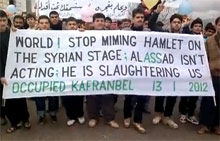
The Guardian finds this English-language sign held up by in Kafranbel, Syria, to be "cryptic."  Why?
(Gotta love the different colored ink on "ASSad," too.)

Wednesday, July 6, 2011

Shakespeare... at a Damascus bus stop

One might not think there would be time for theatre in Damascus these days, let alone Shakespeare, but apparently the Bard makes a cameo (along with some of his characters including Othello and Juliet) in an absurdist play being staged tonight and tomorrow at the Higher Institute for Dramatic Arts in Damascus.  Read more here (in Arabic).  The rhyming title might be translated "The Position of Ezbekia on the Crisis of Drama."  Not very easy to tell from this (unfavorable) review what the show was about, except that it made a perhaps awkward effort to integrate references to current events including random arrests, conversations between ghosts, etc.

Wednesday, April 20, 2011

Syrian student "Twelfth Night" production

Amid everything happening in Syria, students at the Higher Institute for Dramatic Arts put on a production of Twelfth Night (of all things) earlier this month.  `Ajaj Salim directed.

From the few pictures available it does not look like political allusions were the order of the day.  Too bad: one could have a lot of fun with Malvolio.

The show then traveled to Sharjah, where it received warm reviews in Al-Bayan and Al-Ittihad (both in Arabic).  Here's the press release with more background info.

Tuesday, May 18, 2010

Twelfth Night in Damascus

I just came across the Damascus Shakespeare Festival, and apparently it aspires to be annual. However, this year's performance of Twelfth Night by the Birmingham Theatre troupe (visiting from England) seems to have left the Syrian audience cold. The review quotes a Syrian actress named Yara Sabri wishing the show had had more music and dancing etc. to "contribute to the arts education" of a less elite audience. No surprise there. If ever there were a problematic play for cross-cultural presentation, surely Twelfth Night must be it.

Tuesday, April 20, 2010

TV report on Shakespeare festival in Damascus

TV report here (in Arabic) on recent Shakespeare Festival held in Damascus, including Birmingham Theatre's performance of Twelfth Night.

Tuesday, May 27, 2008

Al-Bassam in Damascus

Have to ask Sulayman about this (from the Abu Dhabi-based, English-language National. It must have been hair-raising and very satisfying. Not because of any "catch the conscience of the king" effect -- current rulers can sit brazenly through anything. Rather, perhaps, because of the effect on the rest of the audience watching the play in the ruler's presence. (Especially since Fayez Kozak is such a stage and film star in his native Syria.)

The play’s the thing… and so is a president in the audience
Hamida Ghafour

President Bashar Asad and his beautiful wife Asma, a former investment banker, are frequently seen on Damascus’s cultural circuit.
Recently, Shakespeare’s Richard III was brought to the Damascus stage after the city was named the Arab cultural capital of 2008. The Kuwaiti director, Sulayman al Bassam, reworked the play...
A good friend of mine related this anecdote to me after he watched the play. It was due to begin at 8pm but the crowd grew restless as an hour went by without any sign of the play starting.
“Two seats were being kept empty, obviously for someone senior,” he related. Finally who should walk in but Mr Asad and his wife. The president gave a gangly wave of the hand before sitting down. My friend was quite nervous at what he would make of the play. But he followed it intently and visibly cowered when a pistol was pointed at “Emir Gloucester”.
The audience waited expectantly during a sarcastic scene near the end when Gloucester, with mock reluctance, accepts the crown after a vote in which 99 per cent of the population endorses him. “What happened to the other one per cent?” someone asks. “Oh,” came the dry reply, “they were trying to vote by phone or online but ran out of credit.” Mr Asad – endorsed by 97 per cent of the vote in the last referendum – laughed heartily.


More here.

Tuesday, January 2, 2007

Syrian ambassador to Pakistan Riad Ismat on directing Shakespeare

Syrian playwright, cultural bureaucrat, and diplomat Riad Ismat is now Syrian ambassador to Pakistan.  In this capacity he addressed a local Shakespeare society at Greenwich University.  His (not very well covered) remarks there seem to have been quite general, as befits a diplomat; for more details see his essay هاملت كما اخرجته in his collection شيطان المسرح.

Friday, February 10, 2006

Hamlet's "Something is Rotten" used in controversy over Danish cartoons

The photo is missing for some reason, but there is a striking entry about the use of Shakespeare in the Danish cartoon controversy  on Kristine Steenbergh's blog, Serendipities.  Here it is:

The Dutch newspaper NRC Handelsblad this week featured this photo :

The photo captures a moment in a demonstration in the Syrian capital Damascus, one of the many demonstrations protesting against the cartoons placed in the Danish newspaper Jyllands-Posten. We see a large group of male demonstrators carrying signs in Arabic, signs that I cannot read. The male protestors are captured either with their eyes closed, or looking at each other and each others’ signs. In the foreground of the picture is a woman who looks straight into the camera of Dirk-Jan Visser, press photographer at Reuters. She carries a sign that I can read, with a quotation that is immediately familiar.
What is Shakespeare doing in Damascus? What do Marcellus’ words, spoken in the depth of night on the watchtower of Elsinore, mean in this woman’s hands? She is looking us into the eye, addressing us in English, and she speaks in the words of one of Europe’s most canonical authors. The authority – the cultural capital – of Hamlet’s canonical status is strategically entered into the demonstration, to make a point about the decadence of European culture. The Tragedy of Hamlet, Prince of Denmark is thrown back at the Western world. Shakespeare’s revenge tragedy, as a symbol of European culture, is here appropriated with a vengeance.